







Blog: From low-sulphur to renewable: what a fragmenting fuel mix means for oil spill response
Contingency plans written before 2020 generally rested on one assumption about the pollutant: that it would behave like ”conventional” fuel oil which stay in liquid form. Floating, spreading, becoming more viscous as it cooled, but remaining workable by equipment designed for viscous product. Two shifts have since undermined that assumption, and neither of them is visible from the outside of the vessel carrying the fuel.
What low-sulphur fuel oils changed
The sulphur cap brought a generation of very-low and ultra-low sulphur fuel oils onto the market, produced by a range of blending routes rather than a single specification. The IMAROS project, which characterised a set of these fuels, found an unusually wide spread of physico-chemical properties across the samples tested. For a responder, that spread is the problem in itself: knowing a vessel was carrying VLSFO says considerably less about how the spilled product will behave than it used to.
The variable that matters most is wax and paraffin content, and the pour point that follows from it. Where the pour point of the spilled product sits comfortably below sea temperature, the fuel behaves conventionally: viscosity climbs as it cools, but the slick stays continuous and can be drawn into a recovery device. Where the pour point sits above sea temperature, wax formation begins and the behaviour changes. The slick stops acting as a liquid and starts acting as a solid sheet. A recovery device takes hold of the first section, the remainder fractures at the edge of contact, and what is left stays on the water. Pushing the device further into the slick repeats the same result.
Operationally, some of these fuels can solidify rapidly or fragment into tar-like pieces, which makes them difficult both to corral and to recover with standard equipment. Recovery rates fall sharply, and for stationary devices the operation can become unviable altogether. Advancing systems, which maintain relative velocity against the slick, hold contact where stationary devices lose it.
OSR stockpiles specified before 2020 were built around conventional fuel oil properties, and a significant share of the fuel products now in circulation fall outside that envelope.
Testing skimmer modifications in ice and open sea: the IMAROS 2 project
IMAROS 2 ran from 2024 to the end of 2025 as the follow-up to the original project, with two objectives: improve understanding of low-sulphur fuel oil behaviour to support response decision-making, and improve mechanical recovery and shoreline response capacity.
The second objective is what makes the project relevant to equipment specification. Rather than stopping at characterisation, IMAROS 2 brought skimmer manufacturers into the work directly, running trials in Norway (Horten, 2024) and Finland (Kotka, 2025) to test physical modifications for use in open sea and in ice-infested waters. Laboratory and pilot-scale work at Cedre simulated North Sea conditions at 5°C alongside Mediterranean conditions at 25°C. The Mediterranean case was included in anticipation of the Sulphur Emission Control Area (SECA) designation that has since taken effect: SECAs are sea areas designated under MARPOL Annex VI where the sulphur limit for marine fuel is 0.10% m/m, against 0.50% m/m outside them. The Mediterranean limit applied from 1 May 2025, making it the fifth such area alongside the Baltic, the North Sea, the North American area and the US Caribbean at the time.
We took part as one of the participating manufacturers. Equipment testing ran in two rounds. At Horten in autumn 2024 our work centred on the feeder module for the LAM 50 and heating for the GTA pump. The Finnish round in early 2025, conducted in ice, focused on bucket skimmer modifications for recovery in ice-infested water.
Renewable blends enter the picture
The second shift is less advanced but moving faster.
To reduce greenhouse gas emissions, operators are adopting biodiesel blends: fatty acid methyl esters (FAME), hydrotreated vegetable oil (HVO) and Fischer-Tropsch fuels, blended with marine gas oil or very low sulphur fuel oil at ratios such as B20, B30 and B50.
Their commercial advantage is that they are drop-in fuels, compatible with existing engines and existing bunkering infrastructure without significant technical modification. That same property is what makes them an operational blind spot. A vessel burning B30 presents no external difference from one burning conventional fuel, and nothing in a routine port call establishes which is aboard.
What European testing found
The European Maritime Safety Agency commissioned a study on biodiesel and bunker fuel blends as marine pollutants, carried out by the World Maritime University and Cedre, with the final report published by EMSA in February 2026.
Its principal conclusion is worth stating without qualification: the transition to biodiesel blends can be supported within existing oil spill response frameworks, and no fundamentally new class of response system is required. The blends float, spread and form surface slicks broadly comparably to conventional marine fuels, and standard containment, recovery and sorbent methods apply.
The qualifications are where the operational interest lies. The blends evaporate less and biodegrade faster than conventional fuels, and thin slicks are harder to detect. In recovery testing on fresh and emulsified B30 blends, the choice of skimming principle mattered more than it does with conventional product. Weir skimmers achieved high recovery rates but with reduced selectivity, which places the burden on downstream water separation capacity. Oleophilic drum skimmers achieved high selectivity, but only where oil contact was actively maintained: dynamic operation was required to prevent a water film forming at the drum surface and degrading recovery efficiency.
The practical reading is that the equipment works, but the tolerance for a poorly matched configuration has narrowed. The study's recommendations follow directly: contingency plans should address biodiesel blends explicitly, and responder training and exercises should reflect them.
Why the low-sulphur capability carries forward
There is a useful continuity between the two transitions, and it runs in the responder's favour.
Biodiesel blends are not a new substance class. They are built on a conventional base of marine gas oil or very low sulphur fuel oil, with renewable content added, and HVO is paraffinic in character. The EMSA testing observed that in colder water some blends thickened and formed wax-like residues as they weathered, with weathered B30 HVO and VLSFO blend forming discrete balls after seven days.
The common factor is cold water. Blends that thicken and form wax-like residues as they weather call for the same recovery approach as high pour point low-sulphur fuel oils: brush chain and bucket skimmer technology, heated transfer, and winterised configurations proven in ice trials.
Matching recovery method to fuel
The operational conclusion across both transitions is the same. Fuel type is no longer a detail to be established after the fact. It determines which recovery method will work.
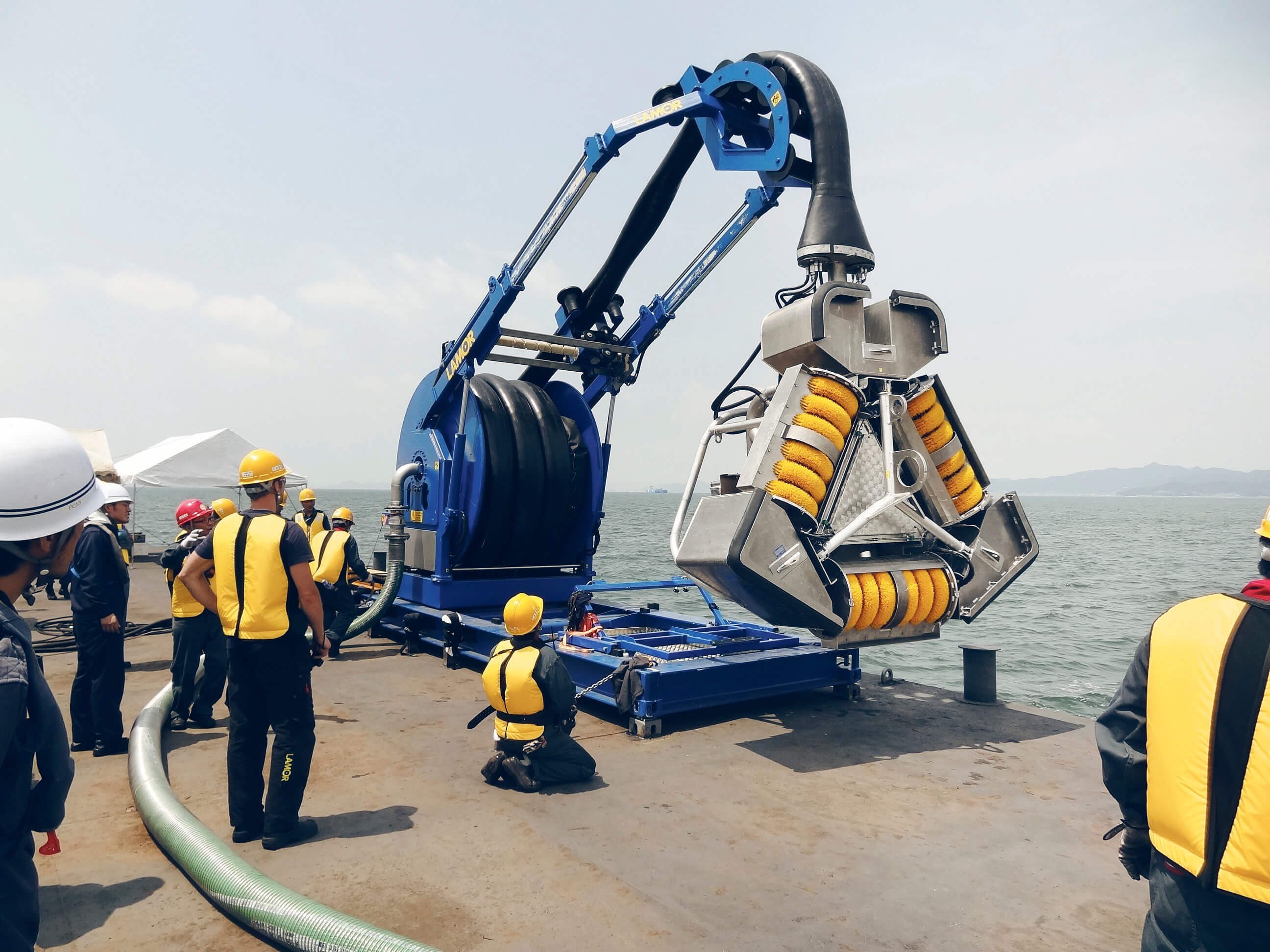
- Brush wheel and brush chain systems. Oleophilic adhesion across a wide viscosity range, with free water content in recovered product below 2%. The default where oil character is uncertain at the point of deployment.
- Bucket skimmers. Deployed stationary from a vessel crane, excavator or dredging machine, combining brush wheel recovery with a scooping function that suits semi-solid and fragmented material, including ice particles. Winterised configurations add heated hopper, heated scraper and hot water injection.
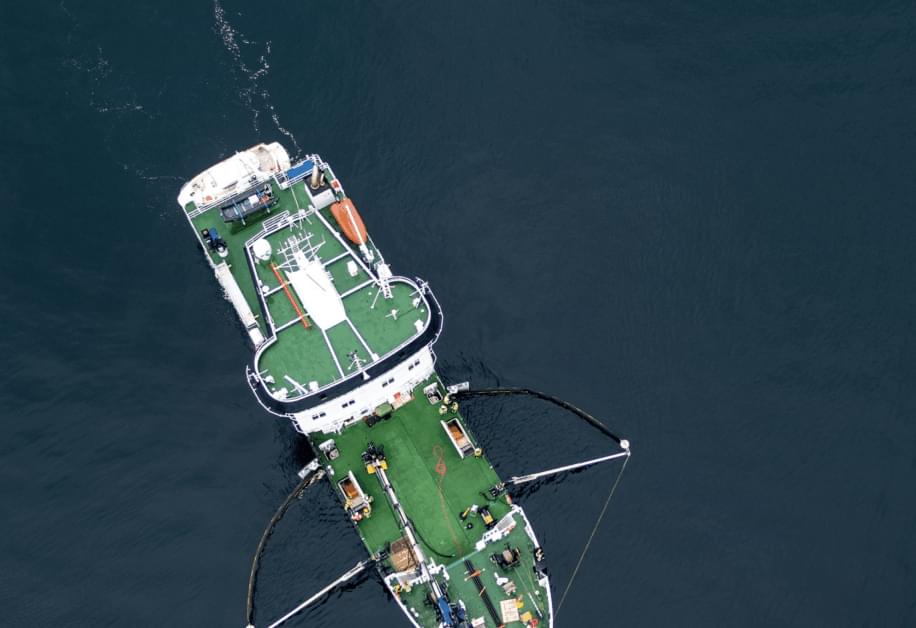
- Advancing systems. Vessel-mounted and side-collector configurations that maintain relative velocity against the slick, holding contact where a stationary device loses grip on a fractured layer.
- Weir systems. Throughput at the cost of selectivity, which makes decanting and water separation capacity the governing constraint rather than skimmer rating.
- Heated transfer and storage. Heated screw pumps and heated storage determine whether recovered product can be moved and held once it is aboard, which is frequently the limiting factor with high pour point material rather than the recovery step itself.
None of this is a new principle. What has changed is how often an unconsidered default now produces a poor result. Finnish rescue authorities have specified against that risk directly. Five rescue departments covering Southwest Finland, Western Uusimaa, Helsinki, Eastern Uusimaa and Kymenlaakso have ordered skimmer system packages comprising 15 containerized units, with a total order value exceeding EUR 2 million and delivery during 2026, specified for the recovery of renewable fuels.
Specification follows the temperature envelope
The Cedre work tested at 5°C and again at 25°C, and the reason matters more than the results from either condition alone. The same fuel, or the same blend, presents a different recovery problem depending on where it is spilled.
In cold water, pour point governs. Product sets, slicks fracture rather than flow, and recovery depends on maintaining contact with a discontinuous layer. Advancing systems, bucket skimmers, heated transfer and winterised configurations are not optional refinements in these conditions; they determine whether recovery proceeds at all.
In warmer water, the wax behaviour largely does not appear. What remains is the selectivity problem: thin slicks that are harder to detect, recovered product with high free water content, and water separation capacity as the practical constraint on throughput.
Both problems are expanding. The Canadian Arctic and the Norwegian Sea became the sixth and seventh Emission Control Areas on 1 March 2026, with the 0.10% sulphur requirement applying from 1 March 2027, and the North-East Atlantic follows on 1 September 2027 as the largest area designated to date. Low-sulphur fuel is becoming the operating norm across a growing share of world traffic, and the most recent additions extend into Arctic and sub-Arctic waters.
There is no global default specification that answers both conditions. A stockpile assembled for temperate open water will underperform in ice, and a stockpile specified for Nordic conditions carries capability that warmer regions are paying for without needing.
What to check
For anyone reviewing preparedness against this, five questions establish most of the position:
- Which fuels move through your area of responsibility, at what blend ratios, and at what pour point? Pour point is normally defined in the fuel specification, and it is the single most useful figure for anticipating recovery behaviour in your local temperature range. Bunkering data and port statistics establish the rest more reliably than assumption.
- Does your contingency plan name them? A plan that refers only to "oil" or "fuel oil" is not wrong, but it will not tell a responder which recovery strategy to select.
- Does your stockpile match your temperature envelope? Specifically, whether you hold advancing capability, heated transfer and storage, and configurations validated at sea temperatures below the pour point of the fuels in local circulation.
- If a SECA requirement takes effect in your area in 2027, does your specification already account for it? Response equipment procurement runs on multi-year cycles, so the decisions taken now are the ones that will meet it.
- Have your people been exercised on it? Equipment specified correctly and operated on the wrong assumption produces the same result as equipment specified incorrectly.
The first four are equipment, planning and procurement questions, and they are solvable with the information already available. The last is the one the European testing singled out, recommending that responder training and exercises be updated to reflect the fuels now in circulation. It is also the one most often deferred.
Stay in the know
Sign up for our newsletter to learn more about innovations enabling the survival of our dear planet.